

Where MSMEs Lose Time and Money Every Day
Running an MSME often means managing customers, employees, inventory, sales, approvals, and reports with limited time and resources. As the business grows, simple processes can gradually turn into daily bottlenecks.
Spreadsheets become harder to maintain, customer information gets scattered, approvals take longer, and employees spend more time on repetitive administrative work. Meanwhile, owners may struggle to get a clear picture of what is happening across the business.
A custom app for small business can help organize these workflows, reduce manual work, and give teams better visibility over daily operations. The following problems are some of the most common signs that an MSME may benefit from a more structured digital system.
At first, those systems may work perfectly well.
A spreadsheet can manage twenty customers.
A group chat can coordinate five employees.
A notebook can track a few orders.
However, problems begin when the business grows.
More customers create more records. More employees create more handoffs. More orders create more opportunities for mistakes. Eventually, processes that once felt simple begin consuming hours of administrative work every day.
That is usually when business owners start asking whether technology can make operations easier.
The answer is often yes.
However, the goal should not be to build an app simply because applications are popular.
Instead, the goal should be to identify the daily business problems that are costing your company time, money, visibility, or customer satisfaction—and determine whether a custom business app can solve them more efficiently.
This guide explores ten common operational problems MSMEs face and the types of custom applications that can help solve them.
What Is an MSME?
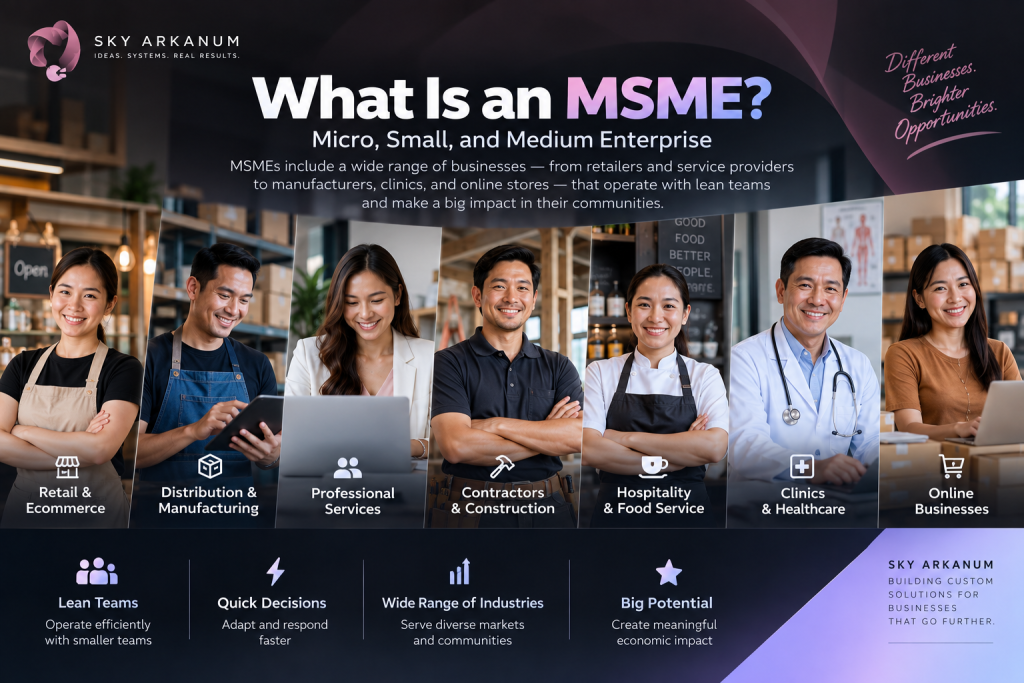
MSME stands for micro, small, and medium enterprise.
Although the exact legal definition varies between countries, MSMEs generally include owner-operated businesses, growing companies, professional service providers, retailers, distributors, manufacturers, hospitality businesses, clinics, contractors, ecommerce companies, and other organizations that operate with relatively lean teams.
These businesses often have one important advantage: they can make decisions quickly.
However, they can also experience operational pressure sooner because employees frequently handle several responsibilities at once.
A salesperson may also update customer records.
A manager may approve purchases while handling scheduling.
An owner may review inventory, payments, employee attendance, customer inquiries, and sales reports in the same day.
Therefore, even small improvements in daily processes can create meaningful results.
Why a Custom App for Small Business Can Improve Daily Operations
Most operational problems do not suddenly appear.
Instead, they slowly accumulate.
One employee creates a spreadsheet.
Another employee creates another spreadsheet.
Customer inquiries arrive through social media, email, SMS, and messaging apps.
Inventory is updated separately.
Approvals happen through chat.
Reports are prepared manually.
Before long, the business may have plenty of data but no single reliable place to understand what is actually happening.
A custom app for small business can bring selected workflows together into one structured system.
For example, instead of employees manually copying customer information from an inquiry into a spreadsheet, then sending the details through chat, then creating another record for billing, the application can move the information through each stage automatically.
The objective is not necessarily to replace every tool your business already uses.
In many cases, the smarter approach is to connect the important ones and build a custom layer around the processes that are unique to your business.
That leads us to the first common problem.
1. Manual Data Entry Is Consuming Too Much Time
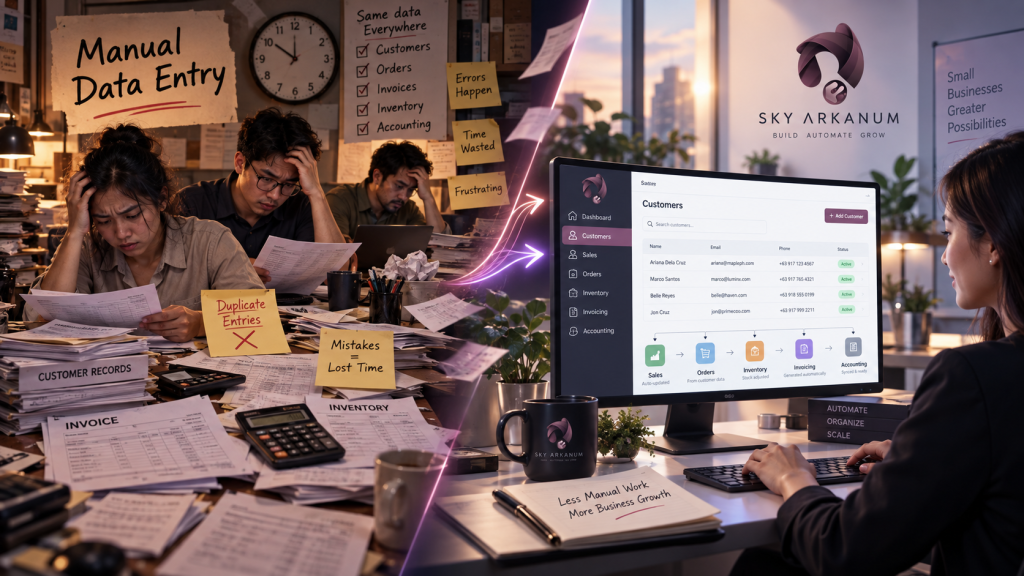
Manual data entry is one of the most common operational problems in growing businesses.
Employees may repeatedly type the same information into:
Customer records.
Sales spreadsheets.
Inventory files.
Order trackers.
Accounting systems.
Reports.
Email templates.
Internal forms.
Besides consuming time, repeated data entry increases the chance of mistakes.
For example, imagine a service company receiving a new customer request.
An employee might copy the customer’s name and contact information into a spreadsheet. Later, another employee creates a job record. Someone else then enters the same details into an invoicing system.
Three people have now handled the same information.
Consequently, a typo or missed update can create inconsistent records.
How a Custom App for Small Business Can Help
A custom app for small business can create one central record and allow that information to move through the workflow automatically.
A customer inquiry could become a sales lead.
Once approved, the lead could become a customer.
After an order is created, the system could automatically associate it with the customer record.
When the order is completed, relevant information could be passed to invoicing or accounting software.
As a result, employees spend less time retyping information and more time completing meaningful work.
For businesses that process dozens or hundreds of similar transactions each week, even a few minutes saved per transaction can become significant over time.
2. Slow Approvals Are Delaying Daily Operations
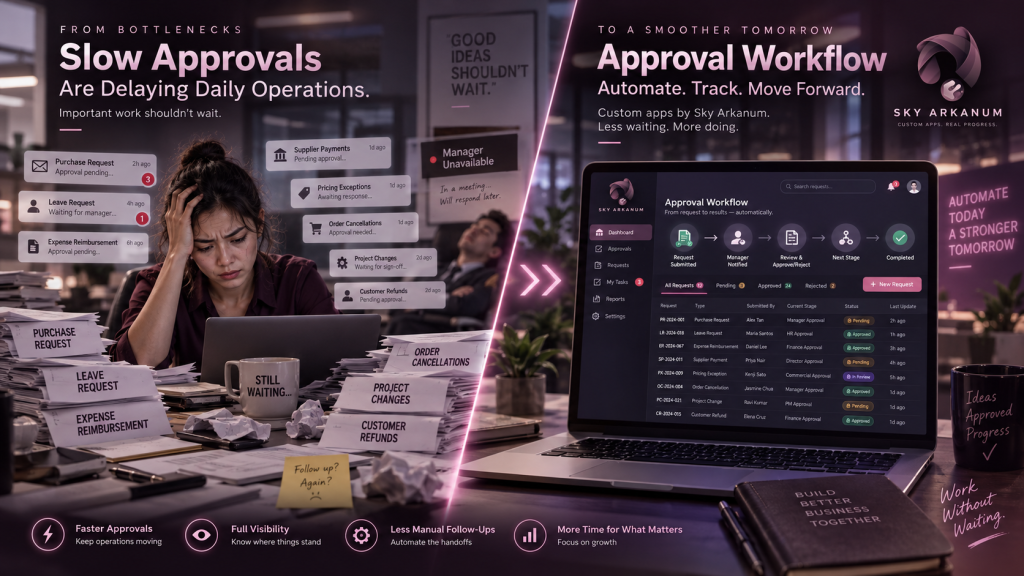
Approvals seem simple until a company starts handling many of them.
Purchase requests.
Discount approvals.
Leave requests.
Expense reimbursements.
Supplier payments.
Pricing exceptions.
Order cancellations.
Project changes.
Customer refunds.
Without a structured system, approvals often happen through email or messaging applications.
For example, an employee sends a request to a manager.
The manager is busy and does not respond immediately.
Later, another message pushes the request further down the conversation.
Eventually, the employee follows up.
Meanwhile, the process remains stuck.
The App Solution: Approval Workflow System
A custom approval application can route requests automatically.
An employee submits a request.
The correct manager receives a notification.
The manager can approve, reject, or request additional information.
Afterward, the system records the decision and automatically moves the request to the next stage.
Furthermore, different rules can apply depending on the request.
For instance, purchases below a certain amount might require one approval, while larger expenses require two.
The result is a process that becomes trackable instead of dependent on memory.
3. Inventory Errors Are Causing Stock Problems
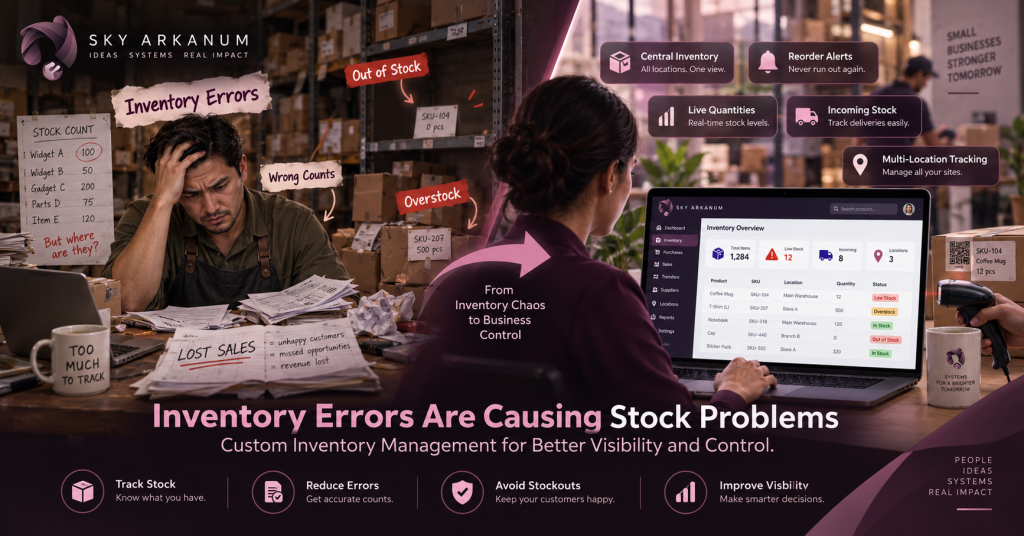
Inventory mistakes can directly affect revenue.
A system may say ten products are available when there are actually three.
Employees might discover that an item is out of stock only after a customer places an order.
Alternatively, a business may purchase too much inventory because nobody has an accurate view of current quantities.
These problems become even more difficult when inventory exists across several branches, warehouses, stores, vehicles, or sales channels.
The App Solution: Custom Inventory Management
An inventory-focused custom business app can maintain a central record of:
Available quantities.
Incoming stock.
Outgoing stock.
Transfers.
Damaged goods.
Reserved inventory.
Supplier information.
Reorder levels.
Purchase history.
Instead of updating multiple spreadsheets, employees can record inventory activity directly where it happens.
For example, warehouse staff might scan an item when receiving stock.
A salesperson completing an order could automatically reduce available inventory.
Meanwhile, the owner could view current quantities from a dashboard.
The application might also trigger a warning when important products reach minimum stock levels.
Therefore, inventory management becomes more proactive instead of reactive.
4. Customer Information Is Scattered or Getting Lost
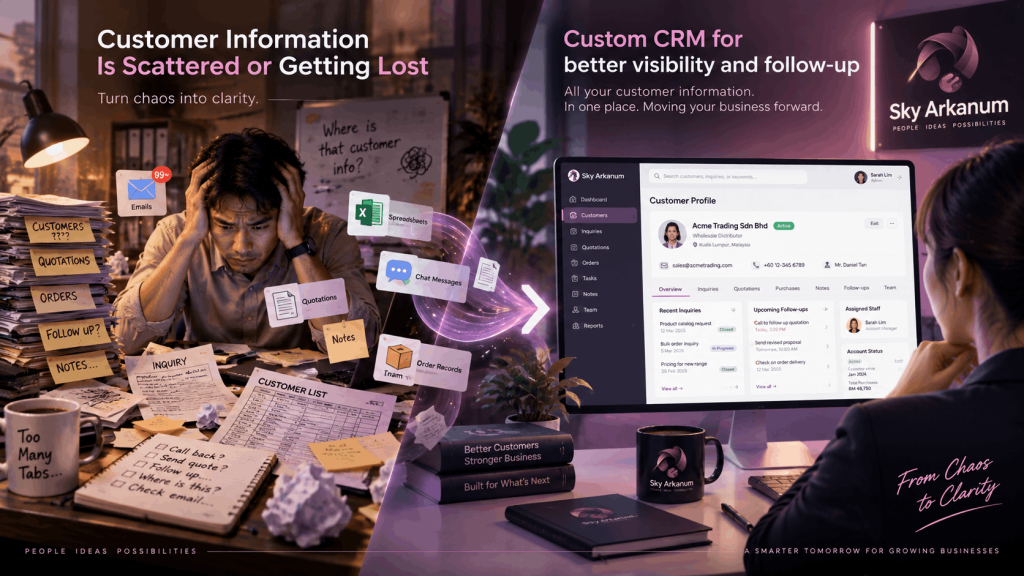
Customer information frequently lives in many places.
Some records may be in spreadsheets.
Others may be inside email.
Sales conversations may be stored in messaging applications.
Order history may exist somewhere else.
As the business grows, employees begin asking questions such as:
When did we last contact this customer?
What did they purchase previously?
Who handles their account?
Did someone already send the quotation?
Does this customer still have an outstanding request?
If the answers depend on asking another employee, the business does not have a reliable customer-information system.
How a Custom App for Small Business Can Create a Better CRM
A custom app for small business can serve as a lightweight CRM tailored to the company’s actual sales process.
Each customer profile can include contact information, inquiries, quotations, purchases, notes, documents, communication history, assigned employees, follow-up dates, and account status.
For example, when a salesperson opens a customer record, they can immediately see the relationship history instead of searching through several systems.
Additionally, automated reminders can alert the team when follow-ups are due.
As a result, opportunities are less likely to disappear simply because someone forgot to follow up.
For MSMEs that rely heavily on repeat customers or relationship-based sales, better customer visibility can become particularly valuable.
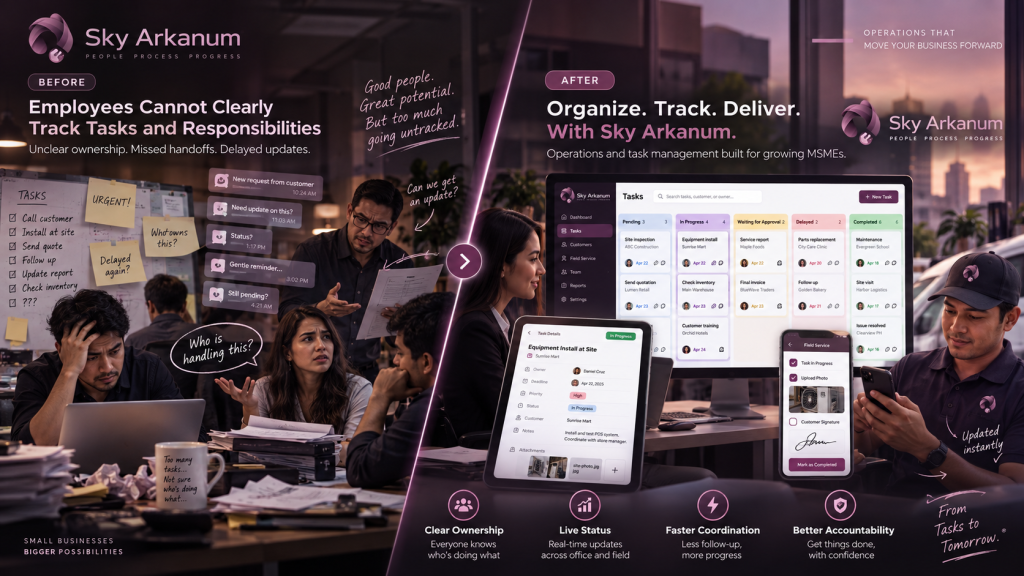
5. Employees Cannot Clearly Track Tasks and Responsibilities
Growing teams frequently struggle with one question:
Who is responsible for this?
A customer request may be mentioned in a group chat.
Someone assumes another employee is handling it.
The task is never formally assigned.
Eventually, the customer follows up.
This problem becomes more common when teams manage many jobs, projects, orders, or customer requests simultaneously.
The App Solution: Operations and Task Management
A custom operations application can turn work into structured tasks.
Each task can have an owner, deadline, priority, status, related customer, notes, attachments, and approval requirements.
Managers can then see which tasks are:
Pending.
In progress.
Waiting for approval.
Delayed.
Completed.
Instead of constantly asking employees for updates, managers can review the current status directly.
Likewise, employees know what requires their attention.
A field-service company, for example, might assign jobs to technicians through the application. The technician can view the job details, upload photos, record completion, collect a signature, and update the status.
Consequently, the office receives the information immediately.
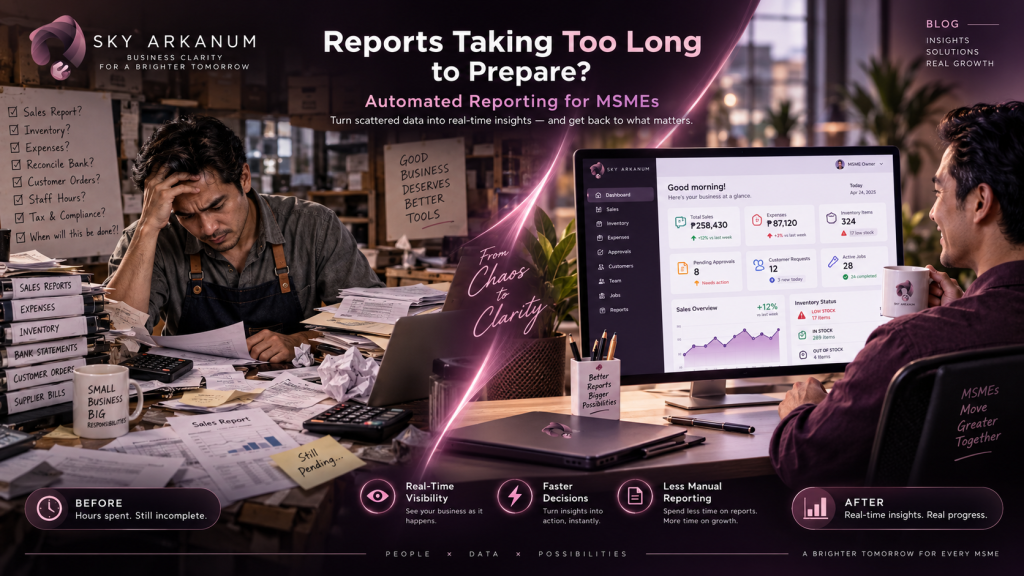
6. Reports Take Too Long to Prepare
Many MSME owners do not lack data.
They lack usable information.
Sales may exist in one file.
Inventory numbers may be somewhere else.
Expenses may come from accounting software.
Employee activity may be tracked separately.
Therefore, answering a simple question such as:
“How did the business perform this week?”
can require someone to compile several reports manually.
By the time the report is finished, the information may already be outdated.
How a Custom Business App Can Automate Reporting
A custom application can collect relevant operational data as employees perform their normal work.
The system can then generate dashboards and reports automatically.
For instance, an owner might see:
Today’s sales.
Orders awaiting processing.
Overdue customer payments.
Low-stock products.
Pending approvals.
Employee workloads.
Open customer requests.
Completed jobs.
Instead of waiting until the end of the week, decision-makers can review information as it changes.
Therefore, reporting becomes part of the operation rather than a separate administrative exercise.
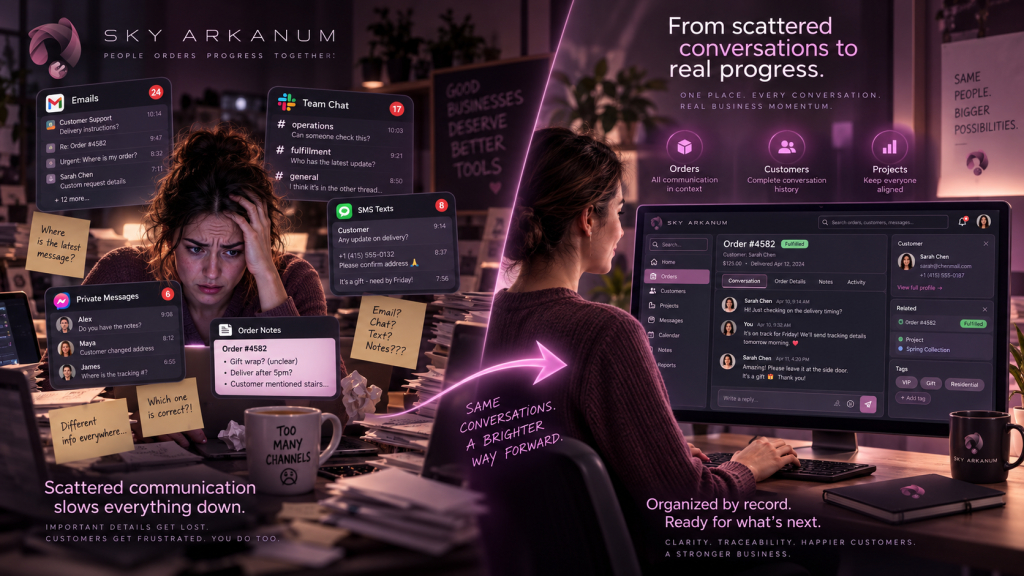
7. Business Communication Is Scattered Across Too Many Channels
Messaging tools are useful.
However, they can become inefficient when they are also used as databases, task managers, approval systems, and customer trackers.
Imagine an employee trying to find a customer’s delivery instruction from three weeks ago.
Was it sent through email?
A team group chat?
A private message?
SMS?
Was it written in the order notes?
The problem is not necessarily the messaging application.
The problem is that important operational information has no structured home.
The App Solution: Centralized Operational Communication
A business operations app can attach communication directly to the relevant record.
For example, discussions about an order remain connected to that order.
Notes regarding a customer remain inside the customer profile.
Updates about a project stay within the project.
Employees can still receive notifications through familiar channels.
However, the official record remains inside the business system.
As a result, important information becomes easier to find even months later.
This approach also reduces dependency on individual employees’ personal message histories.
8. Repetitive Administrative Work Is Taking Employees Away From Customers
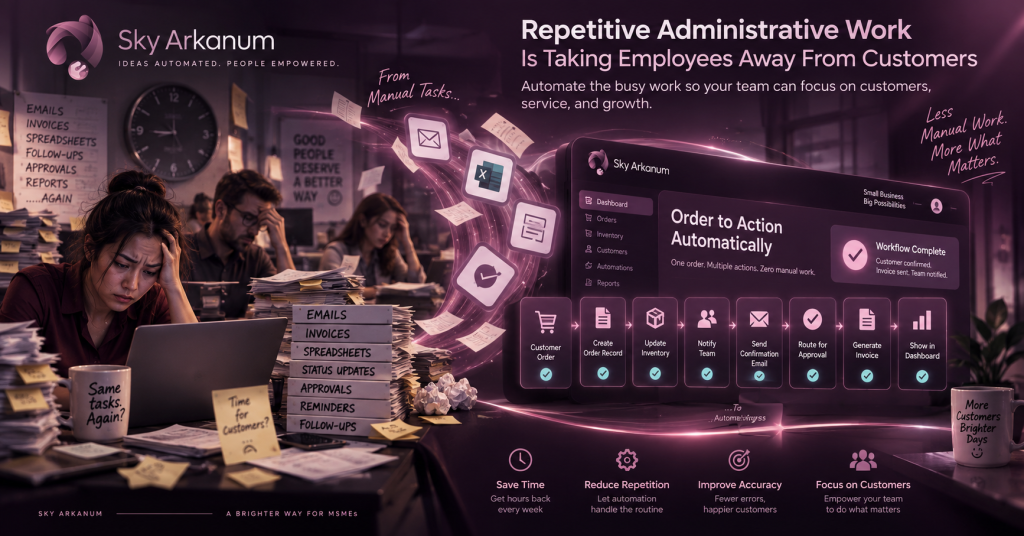
Every business has small repetitive tasks.
Sending confirmation emails.
Creating reference numbers.
Updating order statuses.
Preparing recurring reports.
Sending reminders.
Assigning requests.
Creating invoices.
Updating spreadsheets.
Copying information between systems.
Individually, these tasks may require only a few minutes.
Collectively, however, they can consume many hours every week.
How a Custom App for Small Business Can Automate Repetitive Work
A custom app for small business can automate predictable steps within a workflow.
For example:
A customer submits an order.
The system creates the order record.
Inventory is updated.
The assigned employee receives a notification.
A confirmation is sent to the customer.
Management sees the new transaction on the dashboard.
Nobody needs to manually coordinate every step.
Similarly, an employee submitting an expense could trigger an approval request automatically.
A completed service job could trigger an invoice.
A customer whose subscription is approaching renewal could automatically enter a follow-up queue.
Automation does not necessarily mean replacing employees.
Instead, it can remove repetitive administrative work so employees can focus on customers, sales, service delivery, and decisions requiring human judgment.
9. Booking and Scheduling Problems Are Creating Customer Friction
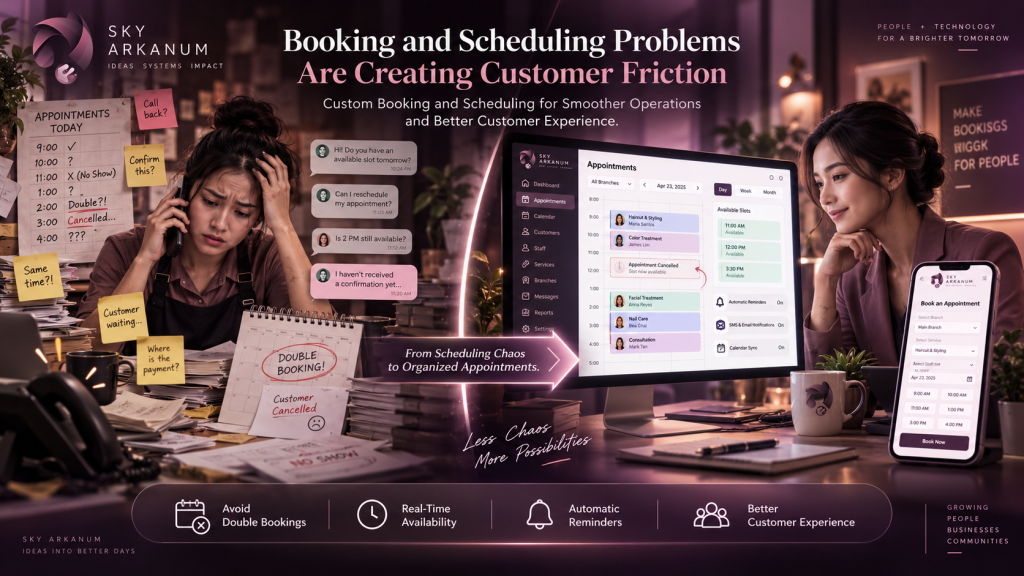
Appointment-based businesses frequently experience scheduling problems.
Customers message employees asking which times are available.
Someone checks a calendar.
Another customer calls.
An employee manually records the booking.
Later, a cancellation happens.
Meanwhile, another staff member may not immediately know that the slot is available again.
This can lead to double bookings, missed appointments, scheduling conflicts, and unnecessary back-and-forth communication.
The App Solution: Custom Booking and Scheduling
A booking application can allow customers or employees to view available times and schedule appointments directly.
The system can account for:
Services.
Employees.
Branches.
Operating hours.
Available equipment.
Appointment durations.
Existing reservations.
For example, a salon could prevent two customers from booking the same stylist at the same time.
A repair company could assign technicians based on availability.
A clinic could automatically send appointment reminders.
Furthermore, cancellations can immediately release time slots back into availability.
Consequently, customers receive a smoother experience while employees spend less time coordinating schedules manually.
10. Owners Lack Real-Time Visibility Into the Business

Perhaps the biggest challenge is not any individual process.
It is the inability to see the entire operation.
Business owners frequently ask:
How many orders are pending?
Which customers need follow-up?
What products are running low?
Who is overloaded with tasks?
What approvals are waiting?
How much did we sell today?
Are projects being completed on time?
When those answers require phone calls, messages, spreadsheets, and manual reports, management becomes reactive.
How a Custom App for Small Business Creates Real-Time Visibility
A custom app for small business can bring critical information into a management dashboard.
Instead of displaying every available number, the dashboard should focus on the metrics that actually influence decisions.
For example, an ecommerce company might prioritize sales, orders, inventory, and fulfillment status.
Meanwhile, a service company may focus on open jobs, technician schedules, outstanding invoices, and customer requests.
A distributor may care most about inventory, sales orders, deliveries, collections, and purchasing.
Because the application reflects the company’s actual workflow, management can see what matters without navigating several unrelated platforms.
Ultimately, visibility allows owners to identify problems earlier.
And problems discovered early are usually easier and less expensive to solve.
What Types of Custom Business Apps Can MSMEs Build?
The ten problems above can lead to many different types of applications.
The appropriate solution depends on the business rather than the technology.
| Business Problem | Possible Custom App |
|---|---|
| Manual data entry | Digital forms and centralized data system |
| Slow approvals | Approval workflow application |
| Inventory errors | Inventory management system |
| Missing customer records | Custom CRM or customer-management app |
| Poor task tracking | Operations and task-management system |
| Delayed reporting | Reporting dashboard and analytics app |
| Scattered communication | Customer/project communication portal |
| Repetitive administration | Workflow automation platform |
| Booking problems | Booking and scheduling application |
| Poor management visibility | Business intelligence dashboard |
Several of these functions can also exist inside one application.
For example, a service business might eventually have one system containing customer records, bookings, employee schedules, job assignments, invoices, and management reports.
However, that does not necessarily mean all of those features should be built on day one.
What Should an MSME Automate First?
A common mistake in digital transformation is trying to fix everything simultaneously.
A better approach is to identify the process creating the greatest operational pain.
Ask three questions.
How often does the problem happen?
A five-minute problem repeated fifty times each day deserves more attention than a two-hour problem that happens once per year.
How much does the problem affect customers or revenue?
Processes causing lost sales, delayed service, incorrect inventory, or customer frustration should generally receive higher priority.
How predictable is the workflow?
Repetitive and rules-based processes are often excellent candidates for automation.
For example, if your business manually copies every online order into an inventory spreadsheet, then sends the same information to fulfillment, that workflow may be a strong candidate for an initial custom application.
Start there.
Solve it well.
Then expand.
Custom App for Small Business vs Off-the-Shelf Software
A custom application is not automatically the best solution.
Sometimes existing software already solves the problem effectively.
For example, if your accounting requirements are standard, established accounting software may be a better investment than building an accounting platform from scratch.
Likewise, businesses with basic project-management needs may be perfectly satisfied with existing tools.
However, problems arise when the business repeatedly adapts its processes around software limitations.
Perhaps employees maintain separate spreadsheets because the existing system does not track something important.
Maybe several subscriptions are required because no single platform supports the complete workflow.
Alternatively, employees might constantly export data from one system and manually import it into another.
Those workarounds are signals worth examining.
A custom app for small business becomes more attractive when the process is unique, strategically important, repetitive, difficult to manage with existing tools, or dependent on several disconnected systems.
You May Not Need a Mobile App
Another important point is that “custom app” does not automatically mean an application customers download from an app store.
Depending on the problem, the best solution may be:
A secure web application.
An internal dashboard.
A customer portal.
A tablet application.
A mobile application.
A desktop application.
Or a system that works across several platforms.
For example, warehouse employees may benefit from a mobile or tablet interface.
Office staff may prefer a browser-based dashboard.
Meanwhile, managers might need access from both their phones and laptops.
Therefore, platform selection should follow the workflow.
Technology should support the business—not force the business to change simply to fit the technology.
What Should Be Included in Version 1?
Once an MSME identifies a problem worth solving, the next challenge is deciding what to build first.
Suppose a distributor eventually wants a complete platform with:
Customer management.
Inventory.
Sales orders.
Purchasing.
Delivery tracking.
Collections.
Employee management.
Analytics.
AI forecasting.
That may be the long-term vision.
However, Version 1 might only require inventory, sales orders, and delivery tracking.
Launching a focused first version allows employees to use the system and provide feedback before the company invests in every planned feature.
This approach is often called an MVP, or Minimum Viable Product.
Importantly, an MVP should still be professionally designed and reliable.
It is smaller in scope—not lower in quality.
How Much Does a Custom App for Small Business Cost?
The price depends on scope.
A focused internal tool with straightforward workflows is very different from a multi-platform application containing payments, real-time data, sophisticated integrations, multiple user roles, AI, and advanced reporting.
The major cost factors typically include functionality, UI/UX design, backend complexity, integrations, supported platforms, security, user roles, infrastructure, testing, and long-term scalability.
If cost is one of your primary questions, Sky Arkanum’s Business App Development Cost in 2026 guide explores these factors in considerably more detail.
How to Know If Your Business Is Ready for a Custom App
The strongest signal is usually not company size.
It is operational friction.
Your business may be ready to explore a custom app for small business if employees repeatedly enter the same information, important processes depend on spreadsheets, approvals frequently get delayed, customer data is scattered, managers struggle to see current operations, several tools need to be manually synchronized, or employees spend significant time completing predictable administrative work.
Another signal is growth.
A process that worked with five employees may fail with twenty.
Likewise, an order system designed for fifty monthly orders may become painful at five hundred.
Software can help the business create structure before operational complexity becomes overwhelming.
Building Custom Business Apps With Sky Arkanum
At Sky Arkanum, we believe the first conversation about application development should focus on the business problem—not programming languages or technical specifications.
Before deciding what should be built, we first need to understand:
What is slowing the business down?
Which employees are involved?
Where does information currently come from?
What happens at each stage?
Which steps create delays or errors?
Which existing tools already work well?
What information does management need to see?
What should happen automatically?
Only then should technology decisions begin.
Depending on the project, Sky Arkanum can help businesses plan and develop solutions such as internal management applications, mobile apps, customer portals, inventory systems, booking platforms, workflow automation, dashboards, ecommerce systems, CRM solutions, MVPs, and other custom digital products.
For suitable projects, cross-platform technologies such as Flutter can also make it possible to support multiple platforms while sharing much of the application’s development work.
However, the right technical approach always depends on the actual project.
Start With the Problem That Costs You the Most
Digital transformation does not have to begin with a huge software platform.
It can begin with one frustrating process.
Maybe employees repeatedly copy information between spreadsheets.
Perhaps inventory is difficult to trust.
Customer follow-ups may be slipping through the cracks.
Managers might be waiting days for reports.
Or the owner may simply be tired of asking everyone for updates before understanding what is happening.
Identify that problem first.
Then ask:
What would daily operations look like if this process worked properly?
That question provides a much better starting point than asking:
“What app should we build?”
The best custom app for small business is not necessarily the application with the most features.
It is the one that solves an important business problem, reduces unnecessary work, gives employees better tools, improves customer experiences, and creates a foundation the company can continue building on.
Ready to Improve Your Daily Business Operations?
If your business is dealing with spreadsheets, manual processes, scattered information, repetitive administrative work, or disconnected systems, Sky Arkanum can help you explore whether a custom application makes sense.
You do not need to arrive with technical specifications.
Start by explaining the business problem.
From there, we can help identify the workflow, determine which features matter most, evaluate appropriate technologies, and plan a practical path from idea to working application.
Talk to Sky Arkanum about your business process and explore what a custom app could solve.
Frequently Asked Questions About Custom Apps for MSMEs
What is a custom app for small business?
A custom app for small business is software designed around a company’s specific processes, users, workflows, and requirements rather than being created for thousands of unrelated businesses. It can be an internal application, mobile app, web system, customer portal, dashboard, booking solution, inventory platform, or another purpose-built tool.
How can an app help daily business operations?
An application can help centralize information, reduce manual data entry, automate repetitive work, track tasks, manage inventory, organize customer records, speed up approvals, improve scheduling, generate reports, and provide management with better operational visibility.
What business process should an MSME automate first?
Start with a frequent process that consumes significant employee time, causes mistakes, delays customers, or makes management difficult. Repetitive workflows with clear rules are often strong candidates.
Is a custom app better than existing business software?
Not always. Existing software is often the right choice for standard processes. Custom development becomes more useful when workflows are unique, existing tools require constant workarounds, several systems need to be connected, or the process creates strategic value for the business.
Does a custom business app need to be on the App Store or Google Play?
No. Many business applications are secure web apps, dashboards, portals, or internal systems. The correct platform depends on who uses the application and where the work happens.
Can custom apps integrate with software we already use?
Yes, depending on whether those platforms provide suitable integration options. Applications can often connect with payment providers, accounting platforms, CRMs, ecommerce systems, email services, cloud storage, analytics platforms, and other services through APIs.
Can a custom app replace spreadsheets?
Yes, particularly when spreadsheets are being used as databases, task trackers, inventory systems, approval tools, or operational dashboards. However, spreadsheets can still remain useful for analysis and ad hoc work.
Can small businesses afford custom application development?
The cost varies widely based on scope and complexity. Starting with one high-value workflow or an MVP can reduce the initial investment compared with trying to build a complete business platform immediately.
What information should I prepare before talking to an app development company?
Start with the problem, who experiences it, how the process works today, what tools are currently used, where delays occur, and what a successful outcome would look like. A development team can help translate those business requirements into technical requirements.
How can Sky Arkanum help an MSME build a custom app?
Sky Arkanum can help businesses evaluate workflows, define features, plan an MVP, design the user experience, develop the application, test it, deploy it, and plan future improvements based on the needs of the project.
Written by Sky Arkanum Technologies · 12 September 2026
Ask us about this