

Business App Development Cost 2026: Avoid Costly Mistakes
Understanding business app development cost is one of the first steps when planning a custom application in 2026. Whether you want an internal management system, customer-facing mobile app, ecommerce platform, booking solution, or entirely custom business application, knowing what drives the price can help you avoid costly mistakes before development begins.
At first glance, app pricing can seem confusing. One development company may quote $15,000, while another may estimate $100,000 or more for what appears to be a similar project.
However, those quotes may represent completely different levels of functionality, design, security, scalability, testing, and long-term support.
So, how much should your business realistically budget?
As a broad 2026 market reference, professionally developed business applications can range from around $10,000 for a focused project to $250,000 or more for advanced custom platforms. Meanwhile, large enterprise applications can exceed $500,000 when they involve complex infrastructure, integrations, security, and business processes.
Fortunately, you do not need to guess.
In this guide, we will explain what affects business app development cost, what different types of applications may cost, which expenses businesses frequently overlook, and how to plan a smarter development budget.
Business App Development Cost in 2026: Quick Pricing Guide
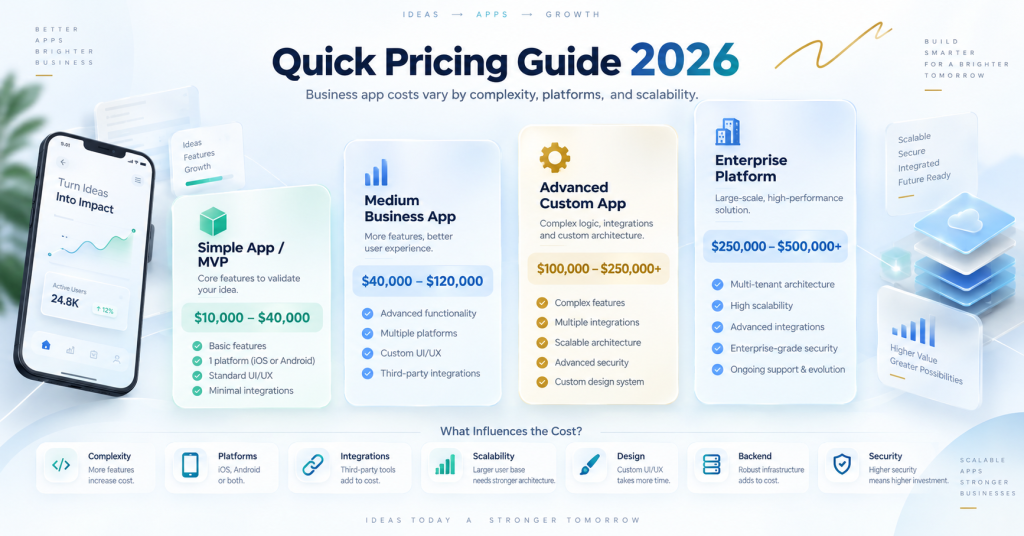
Current industry pricing varies significantly because the word “app” can describe anything from a simple internal tool to a large enterprise platform.
For example, Clutch’s app development pricing research shows many reviewed mobile application projects falling within the $10,000 to $49,999 range. However, more sophisticated projects can cost substantially more.
Similarly, broader industry research from GoodFirms places custom application development across a much wider range depending on complexity, platforms, development approach, integrations, and scalability.
As a practical starting point, businesses can think about business app development cost using the following ranges:
| Type of Business App | Typical Market Budget |
|---|---|
| Simple business app or focused MVP | $10,000–$40,000 |
| Medium-complexity business app | $40,000–$120,000 |
| Advanced custom business app | $100,000–$250,000+ |
| Enterprise application | $250,000–$500,000+ |
These figures are market benchmarks rather than guaranteed prices.
In practice, two applications that look almost identical to customers can require completely different systems behind the scenes.
For instance, imagine two businesses requesting an appointment-booking app.
The first business may only need customers to choose a service, select a date, enter their contact details, and receive confirmation.
By contrast, the second business may require multiple branches, employee schedules, dynamic availability, online payments, automated reminders, cancellations, customer accounts, loyalty points, analytics, accounting integrations, and a complete administration dashboard.
Technically, both are booking applications.
Nevertheless, their development requirements—and therefore their costs—are very different.
What Is a Business App?

A business app is software designed to help an organization improve customer experiences, automate operations, manage information, create new revenue opportunities, or make employees more productive.
Importantly, a business app does not always mean a public mobile application listed in the Apple App Store or Google Play.
Instead, it could be:
- A customer-facing mobile application
- An employee-management system
- A customer portal
- A booking platform
- An inventory system
- An ecommerce application
- A sales-management system
- A custom CRM
- A reporting dashboard
- A field-service application
- A workflow automation platform
- A subscription platform
- A custom internal business system
Therefore, the better question is often not:
“How much does an app cost?”
Instead, ask:
“What business problem should this application solve?”
Once the problem, users, workflows, and required features are clear, estimating the project becomes much more reliable.
What Determines Business App Development Cost?

The biggest factor affecting business app development cost is scope.
Every feature requires planning, design, development, testing, and maintenance. In addition, every new user role, integration, workflow, platform, and automation can increase the technical workload.
Several factors have the greatest impact.
1. App Complexity
A simple application might contain only a few major features, such as:
- User accounts
- Login and authentication
- Profiles
- Forms
- Basic dashboards
- Notifications
- Content management
- Simple administrator controls
On the other hand, a more sophisticated application might include:
- Multiple user roles
- Online payments
- Subscriptions
- GPS tracking
- Live messaging
- Real-time synchronization
- Inventory management
- Scheduling
- Advanced reporting
- File uploads
- API integrations
- Workflow automation
- Artificial intelligence
- Advanced administrator permissions
However, the number of features alone does not determine cost.
The complexity of each feature matters just as much.
For example, a basic notification that reminds a customer about an appointment is relatively straightforward. In contrast, an intelligent notification system triggered by dozens of customer actions and business rules requires considerably more development.
As a result, feature complexity can have a major effect on the final project estimate.
How UI/UX Design Affects Business App Development Cost

Users experience the application through its interface. Therefore, UI and UX design play an important role in both development quality and cost.
Professional application design may involve:
- User-flow planning
- Wireframing
- Information architecture
- Interface design
- Interactive prototypes
- Responsive layouts
- Usability testing
- Design revisions
- Developer handoff
A simple internal application may not require elaborate visuals or animation.
However, a customer-facing product representing your brand may require a more refined experience.
Moreover, good UI/UX design is not merely decorative.
Clear design helps users understand what to do, reduces mistakes, improves adoption, and makes complicated workflows easier to complete.
Consequently, investing in appropriate UX can reduce problems later in development.
How User Roles Affect Business App Development Cost

User roles are another major pricing factor.
For example, imagine you are building a marketplace.
The application could include three major user types.
Customers might browse products, place orders, make payments, communicate with sellers, and manage accounts.
Sellers might upload products, manage inventory, process orders, review transactions, and communicate with customers.
Administrators might manage users, payments, products, disputes, reports, permissions, and system settings.
Although customers see one overall platform, developers may effectively be building several connected experiences.
As a result, each additional role can introduce new screens, permissions, workflows, logic, and testing requirements.
Therefore, applications with several user types generally cost more than single-user-role applications.
Backend Development and Business App Development Cost

The interface users see is only one part of an application.
Behind it, the backend may manage:
- Databases
- User authentication
- Business rules
- APIs
- File storage
- Notifications
- Payments
- Reporting
- Permissions
- Security
- Administrator tools
- Integrations
For a straightforward application, the backend may be relatively simple.
However, a system serving thousands of users, processing large amounts of data, or supporting real-time transactions requires more sophisticated architecture.
In addition, scalable systems need to be designed so they can grow without becoming unstable or unnecessarily expensive.
Because of this, an application that appears visually simple can still have a high business app development cost if the backend requirements are complex.
How Integrations Affect Business App Development Cost

Most modern businesses already use several digital tools.
Therefore, a new application may need to connect with systems such as:
- Payment gateways
- Accounting software
- CRM platforms
- ERP systems
- Email providers
- SMS services
- Mapping services
- Analytics platforms
- Ecommerce systems
- Inventory platforms
- Cloud storage
- Authentication providers
For example, your app may need to send invoices to accounting software whenever a customer completes a purchase.
Alternatively, it may need to synchronize customers with your CRM or automatically update inventory levels.
Integrations can save time because businesses do not need to rebuild every service from scratch.
However, they also require development, testing, authentication, error handling, monitoring, and maintenance.
Furthermore, some third-party providers charge separate subscription or usage fees.
Therefore, those expenses should be included when calculating total ownership cost.
Platform Choice and Business App Development Cost
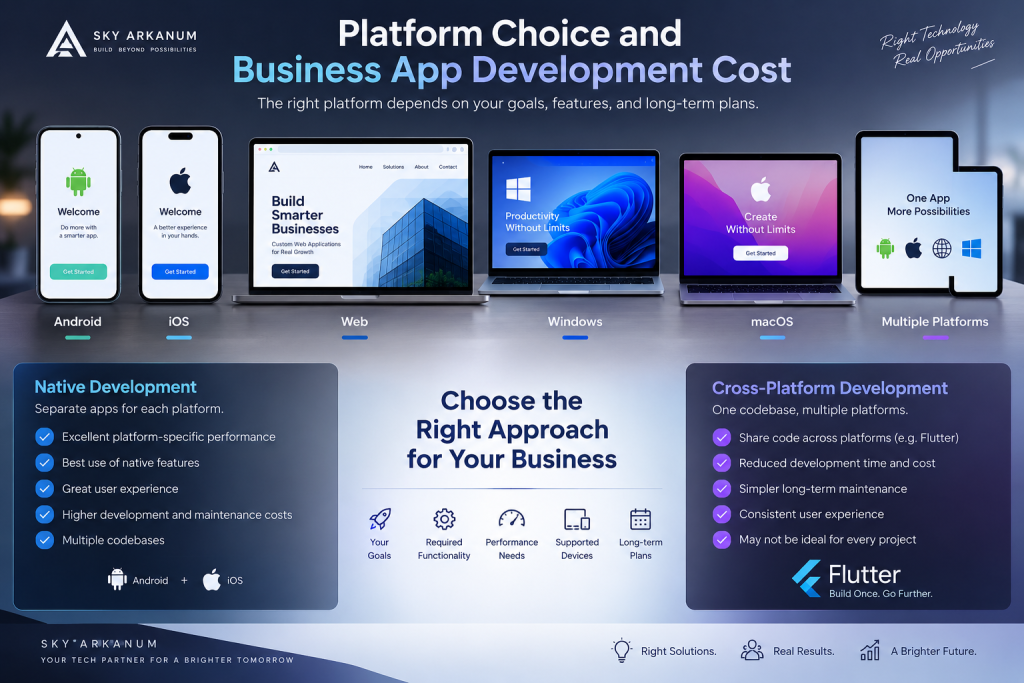
Another important decision is where your application needs to run.
Your options may include:
- Android
- iOS
- Web
- Windows
- macOS
- Multiple platforms
Traditionally, businesses often developed separate native applications for Android and iOS.
That approach can provide excellent platform-specific performance. However, maintaining multiple codebases can also increase development and maintenance requirements.
Alternatively, businesses can consider cross-platform technologies.
Frameworks such as Flutter allow development teams to share much of the code across multiple platforms.
For appropriate projects, this approach can reduce duplicated work and simplify long-term maintenance.
However, cross-platform development is not automatically the right choice for every application.
Instead, the development approach should depend on your required functionality, performance needs, integrations, supported devices, and long-term plans.
At Sky Arkanum, we believe the technology should fit the business requirement—not the other way around.
Security Requirements and Business App Development Cost
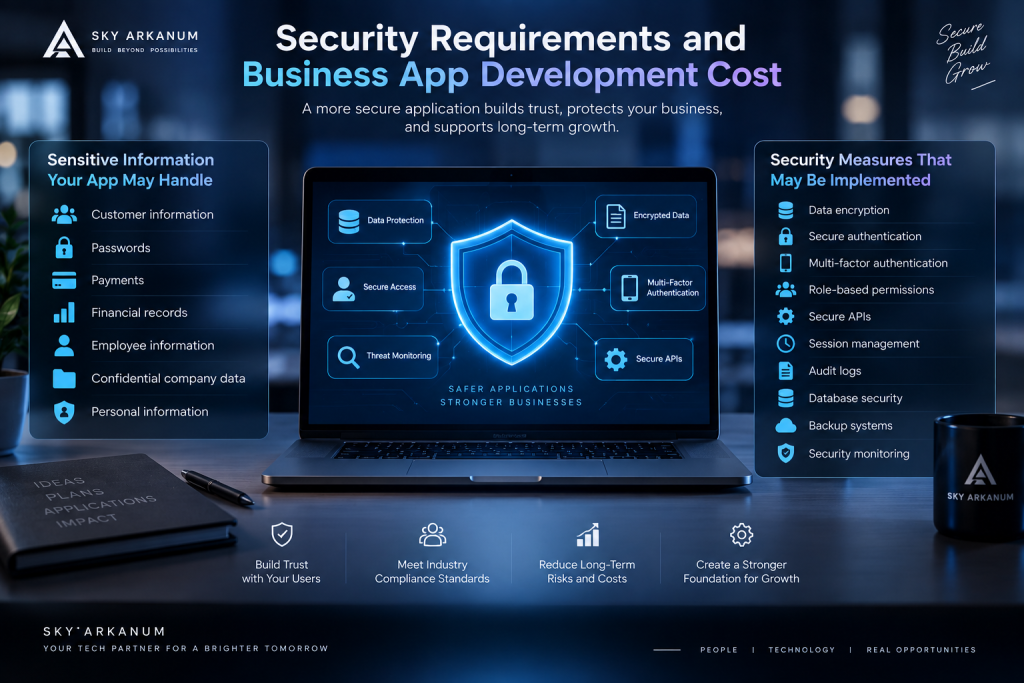
Security becomes increasingly important when an application handles sensitive information.
For example, your app may process:
- Customer information
- Passwords
- Payments
- Financial records
- Employee information
- Confidential company data
- Personal information
Depending on the project, appropriate security measures can include:
- Data encryption
- Secure authentication
- Multi-factor authentication
- Role-based permissions
- Secure APIs
- Session management
- Audit logs
- Database security
- Backup systems
- Security monitoring
In addition, some industries have regulatory or compliance requirements that increase project complexity.
Although security adds development work, reducing it simply to lower the initial project price can create much larger costs later.
Therefore, security should be treated as part of the application’s foundation.
How AI Can Affect Business App Development Cost

Artificial intelligence has become an increasingly common part of business software.
For example, organizations may use AI for:
- Customer-support assistants
- Intelligent search
- Document analysis
- Content generation
- Recommendation systems
- Data classification
- Predictive analytics
- Workflow automation
- Image recognition
- Natural-language interfaces
However, adding AI does not automatically make an application more valuable.
Instead, AI should solve a clear business problem.
For instance, an AI assistant that reduces support workload may provide measurable value. Likewise, document-processing AI could help employees avoid hours of repetitive manual work.
On the other hand, adding AI simply because it is popular can unnecessarily increase development and operating expenses.
Furthermore, AI features may introduce ongoing costs for API usage, model access, data processing, monitoring, and storage.
Therefore, before adding AI, ask:
Will this feature improve revenue, productivity, customer experience, or operational efficiency?
If the answer is unclear, it may be better suited to a future development phase.
Business App Development Cost by Project Complexity
Understanding your project’s complexity can help you create a more realistic starting budget.
Simple Business App Development Cost: $10,000–$40,000
A relatively simple custom business application may fall within approximately $10,000 to $40,000 based on broad professional market benchmarks.
Examples may include:
- Simple employee apps
- Basic booking systems
- Loyalty applications
- Internal request systems
- Data-collection tools
- Simple customer portals
- Basic task-management systems
Typically, these projects have limited user roles, straightforward databases, standard interfaces, and few advanced integrations.
However, simple does not mean low quality.
In fact, a focused application that solves one important problem extremely well can create more value than a complicated product overloaded with unnecessary functionality.
Medium Business App Development Cost: $40,000–$120,000
Medium-complexity applications may fall around $40,000 to $120,000.
For example, projects in this category might include:
- Ecommerce applications
- Booking platforms
- Service-management systems
- Customer portals
- Custom CRM solutions
- Subscription applications
- Inventory-management platforms
- Multi-location business apps
These applications often include several user roles, online payments, dashboards, notifications, reporting, and external integrations.
As a result, development, testing, and backend requirements become more substantial.
Advanced Business App Development Cost: $100,000–$250,000+
Advanced custom applications commonly reach $100,000 to $250,000 or more across the broader development market.
They may include:
- Real-time communication
- Complex workflow automation
- Multiple third-party integrations
- AI functionality
- Advanced analytics
- Large databases
- Offline synchronization
- Sophisticated security
- Several platforms
- Large numbers of users
Examples include logistics systems, large marketplaces, fintech applications, healthcare platforms, advanced SaaS products, and large field-service applications.
At this level, the development team is building more than an interface.
Instead, they are creating infrastructure that may become an essential part of the business.
Enterprise Business App Development Cost: $250,000–$500,000+
Large enterprise applications can exceed $250,000, while major digital platforms may move beyond $500,000.
These projects can require:
- Enterprise authentication
- Large-scale integrations
- Extensive permissions
- Data migration
- Compliance
- Advanced cybersecurity
- High availability
- Business intelligence
- Detailed audit logs
- Multi-region infrastructure
- Dedicated support
Consequently, enterprise app development often becomes a broader digital transformation initiative.
MVP Business App Development Cost

An MVP, or Minimum Viable Product, is a focused first version of an application.
Rather than trying to build every possible feature immediately, an MVP contains the functionality required to test the core idea.
For example, imagine your full application roadmap contains 30 planned features.
Instead of developing all 30 before anyone uses the product, you might identify the six functions required for customers to receive the core value.
Those six features become Version 1.
After launch, real users can provide feedback.
As a result, the business can make better decisions about what deserves investment in Version 2.
For many new digital products, an MVP can significantly reduce initial business app development cost and project risk.
However, an MVP should not mean poor-quality software.
Instead, think of it as a professionally built but intentionally focused product.
Why Too Many Features Increase Business App Development Cost
A common development mistake is assuming that more features automatically create a better product.
Unfortunately, every feature creates additional work.
It must be designed, developed, tested, secured, maintained, documented, and updated.
Therefore, a feature nobody actually needs creates cost without creating equivalent business value.
A useful approach is to divide features into three groups:
Must Have
The application cannot achieve its main purpose without these features.
Should Have
These features provide significant value but are not required for the first release.
Could Have
These are valuable improvements that can be introduced later.
For example, an ecommerce app may eventually include customer accounts, loyalty points, AI recommendations, referrals, live chat, and advanced analytics.
However, its first release may only need customer accounts, product ordering, payments, and order tracking.
By prioritizing correctly, you can control cost while still building a strong foundation.
Hidden Business App Development Costs to Consider
Development is not the only expense involved in owning software.
After launch, businesses may also need to budget for:
- Cloud hosting
- Database usage
- Domains
- Email services
- SMS usage
- Payment processing
- Third-party APIs
- App-store accounts
- Monitoring
- Backups
- Maintenance
- Bug fixes
- Security updates
- New features
- Customer support
For example, an application serving 1,000 users will usually have different infrastructure requirements from one serving 500,000.
In addition, some services charge based on API requests, storage, transactions, or active users.
Therefore, businesses should evaluate total cost of ownership, not only the initial development quotation.
How Much Does App Maintenance Cost?
App development does not end when the product launches.
Operating systems change. Third-party APIs are updated. Security vulnerabilities are discovered. Customer expectations evolve.
As a result, most serious business applications require ongoing maintenance.
That maintenance may include:
- Security patches
- Bug fixes
- Performance improvements
- Server maintenance
- Compatibility updates
- Database optimization
- Dependency updates
- Monitoring
- Feature improvements
For business-critical software, maintenance should be planned from the beginning rather than treated as an unexpected expense.
Moreover, regular maintenance can help prevent much larger technical problems later.
Freelancer vs Development Company: How Does It Affect Cost?

Businesses can generally choose between freelancers, internal development teams, and development companies.
A freelancer can be an excellent option for a small and clearly defined project.
However, a complete application may require several different disciplines, including:
- Business analysis
- UI/UX design
- Frontend development
- Backend development
- Database architecture
- Quality assurance
- Security
- Deployment
- Project management
- Post-launch support
A development company can bring those functions together under one coordinated process.
Therefore, the initial hourly rate should not be the only factor in your decision.
Instead, compare what is actually included in the quotation.
For example, does the price include UI/UX design, QA testing, project management, deployment, documentation, and warranty support?
A cheaper quote that excludes critical project stages may become more expensive later.
Can You Build a Business App for Less Than $10,000?
Yes, in some situations.
A tightly focused internal tool, low-code solution, proof of concept, prototype, or extremely small application may fall below $10,000.
However, businesses should carefully compare unusually different quotations.
If one developer quotes $7,000 while another quotes $35,000, they may not actually be proposing the same solution.
For instance, differences may include:
- Design quality
- Architecture
- Testing
- Security
- Documentation
- Scalability
- Project management
- Post-launch support
Therefore, instead of asking only:
“Which developer is cheapest?”
Ask:
“What exactly are we receiving for this price?”
That question leads to a much more useful comparison.
Can AI Reduce Business App Development Cost in 2026?
AI-assisted software development is changing how development teams work.
For example, developers can use AI to assist with coding, debugging, documentation, testing, prototyping, and repetitive programming tasks.
As a result, some parts of the development process can become more efficient.
However, AI does not eliminate the need for professional planning, architecture, database design, cybersecurity, UI/UX, quality assurance, deployment, or technical judgment.
In other words, AI can help developers build faster.
Nevertheless, building the wrong product faster is still expensive.
Therefore, the best use of AI is to improve development efficiency while maintaining strong engineering standards.
How to Reduce Business App Development Cost Without Sacrificing Quality
Reducing cost should come from smarter decisions—not from removing the parts of development that protect quality.
Fortunately, businesses have several effective options.
First, define the primary business problem before development begins.
Next, identify the smallest set of features required to solve that problem.
Then, consider an MVP before committing to every planned feature.
In addition, cross-platform development may reduce duplicated work when both Android and iOS are required.
Likewise, existing services can often handle payments, authentication, maps, messaging, or analytics more efficiently than rebuilding every capability from scratch.
Finally, divide the project into clear phases.
For example:
Phase 1: Core application and essential workflows
Phase 2: Automation and advanced reporting
Phase 3: AI, integrations, and additional features
As a result, the business can begin receiving value sooner while controlling initial investment.
How Long Does It Take to Build a Business App?
Timeline and business app development cost are closely connected.
A focused application might take several weeks to a few months.
Meanwhile, medium-complexity projects commonly require several months.
Large applications can take six months, a year, or longer depending on requirements.
The timeline can be influenced by:
- Number of features
- UI/UX complexity
- User roles
- Platforms
- Integrations
- Testing requirements
- Feedback cycles
- Scope changes
- Deployment requirements
Therefore, clear requirements and fast decision-making can help prevent unnecessary delays.
Likewise, avoiding major scope changes midway through development can keep both timeline and budget under control.
Does Your Business Actually Need a Custom App?
Not every business needs an application.
Sometimes, a responsive website, ecommerce store, existing SaaS platform, or customer portal can solve the problem more efficiently.
However, custom app development can make sense when software creates a meaningful competitive or operational advantage.
For example, your business may benefit from a custom app if you need to:
- Automate repetitive manual work
- Provide customers with specialized functionality
- Connect disconnected business systems
- Give employees a dedicated operational tool
- Build a digital product
- Improve field operations
- Create a customer portal
- Build proprietary workflows
- Introduce a new revenue channel
- Create software around your service
Therefore, the goal should not simply be:
“We want an app because competitors have one.”
Instead, the goal should be:
“We have a business problem or opportunity that software can solve.”
That difference matters.
What to Prepare Before Requesting a Business App Development Quote
You do not need to understand every technical detail before talking to a development company.
However, providing clear business information can significantly improve the accuracy of your estimate.
Before requesting a quote, prepare answers to these questions:
- What problem should the app solve?
- Who will use the application?
- What user roles are required?
- What should each user be able to do?
- Which features are essential?
- Which features are optional?
- Do you need Android, iOS, web, desktop, or multiple platforms?
- Which existing systems must connect with the application?
- Will the application process sensitive information?
- What is your preferred launch timeframe?
- What budget range are you considering?
With this information, a development team can translate your business objectives into technical requirements.
As a result, your quotation can be based on an actual project scope rather than guesswork.
Why the Cheapest Business App Development Cost Can Become Expensive
The cheapest initial quotation is not always the lowest-cost project.
For example, weak software architecture may require a major rewrite when the application grows.
Similarly, poor documentation can make future development slower and more expensive.
Security shortcuts can create even larger problems.
In addition, applications built without sufficient testing may require extensive repairs after launch.
On the other hand, unnecessary overengineering can also waste money.
Therefore, the goal should not be to choose the cheapest or most expensive option.
Instead, businesses should look for the right technical solution at the right level of investment.
Building a Custom Business App With Sky Arkanum

At Sky Arkanum, we approach custom application development as a business solution rather than simply a programming task.
Before development begins, we focus on several important questions.
What does your business need to accomplish?
Who will use the application?
Which workflows matter most?
Which features belong in the first release?
Which features can wait?
What development approach offers the right balance between cost, scalability, maintainability, and user experience?
For suitable projects, technologies such as Flutter can also help businesses create cross-platform applications while sharing much of the development work across supported platforms.
However, the technology should always be selected based on project requirements.
Whether you are planning an internal management system, customer-facing application, ecommerce platform, business automation tool, MVP, or completely custom digital product, the best place to begin is defining the problem clearly.
Final Business App Development Cost Guide for 2026
So, what should your company realistically expect to spend?
As a broad market reference:
| Project Complexity | Estimated Market Cost |
|---|---|
| Focused MVP or Simple App | $10,000–$40,000 |
| Medium Business App | $40,000–$120,000 |
| Advanced Custom App | $100,000–$250,000+ |
| Enterprise Platform | $250,000–$500,000+ |
Ultimately, business app development cost depends on your application’s features, users, workflows, platforms, integrations, security needs, infrastructure, and long-term goals.
Your project may cost less than these ranges.
Alternatively, it may require a larger investment.
Therefore, the only reliable way to estimate a custom application is to first understand what the business genuinely needs.
Instead of asking only:
“How much does it cost to build an app?”
Consider asking:
“What is the smartest version of this application we can build to create meaningful business value?”
That question can help reduce risk, control development costs, accelerate launch, and create a stronger foundation for future growth.
Ready to Discuss Your Business App Idea?
If your company has an app idea or a business process that could benefit from custom software, Sky Arkanum can help you turn that idea into a clear development plan.
We can help identify essential features, evaluate development options, organize the project into practical phases, and determine an appropriate path from concept to deployment.
Contact Sky Arkanum to discuss your custom app project and request a project assessment.
Frequently Asked Questions About Business App Development Cost
What is the average business app development cost in 2026?
The business app development cost for a professionally developed application can range from around $10,000 for a focused project to $250,000 or more for an advanced custom system. Enterprise platforms may exceed $500,000 depending on complexity.
How much does it cost to build an app for a small business?
A relatively simple small-business application may fall around $10,000 to $40,000 in the broader professional market. However, advanced functionality, integrations, custom design, and multiple platforms can increase the price.
What affects business app development cost the most?
The biggest factors include app complexity, number of features, user roles, UI/UX design, backend requirements, integrations, platforms, security, infrastructure, and testing.
Is Flutter cheaper than native app development?
Flutter can reduce duplicated development effort for suitable cross-platform projects because much of the application can share one codebase. However, actual savings depend on the app’s functionality and technical requirements.
How much does an MVP business app cost?
A professionally developed MVP can cost approximately $10,000 to $50,000 or more, depending on the features required for the initial release.
Does a business app have ongoing costs?
Yes. Ongoing expenses can include hosting, database usage, maintenance, monitoring, API fees, payment processing, security updates, backups, and future development.
How long does it take to build a business app?
A focused application may take several weeks to a few months. Meanwhile, more sophisticated projects can require six months, a year, or longer.
How can I lower business app development cost?
Start with clear requirements, prioritize essential features, consider an MVP, use cross-platform development when appropriate, avoid unnecessary integrations, and divide larger projects into phases.
How do I get an accurate app development quote?
Provide your development company with the business objective, target users, required features, platforms, integrations, security requirements, timeline, and approximate budget. The team can then create a project scope and more accurate estimate.
Is custom business app development worth the investment?
It can be when the application reduces operational costs, automates repetitive work, creates new revenue, improves customer experience, or gives the business a capability that existing software cannot provide.
Written by Sky Arkanum Technologies · 11 September 2026
Ask us about this